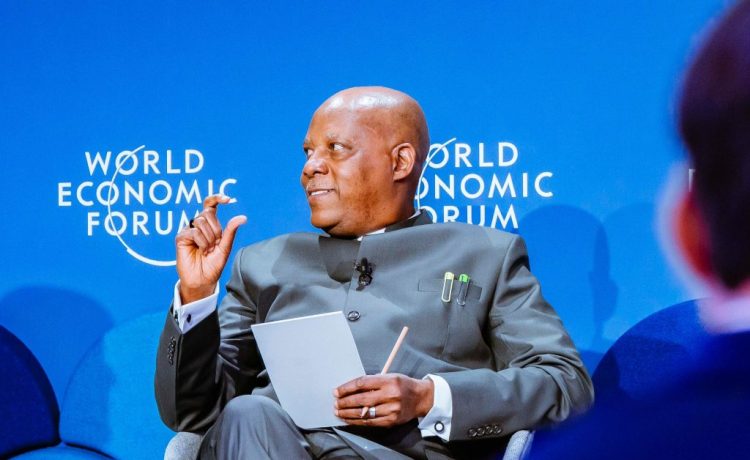
Vice President Kashim Shettima has stated that Nigeria no longer views food security as merely an agricultural issue but as a critical macroeconomic, security, and governance concern.
Speaking at a high-level panel titled “When Food Becomes Security” during the 56th World Economic Forum (WEF) in Davos, Switzerland, VP Shettima said the Federal Government is implementing a multi-dimensional agricultural drive aimed at insulating the country from global shocks while boosting productivity in key food basket regions.
“In Nigeria, we don’t look at food security purely as an agricultural issue. It is a macroeconomic, security and governance issue. Our focus is to use food security as a pillar for national security, regional cohesion and stability,” he said.
According to the Vice President, Nigeria’s food security strategy is anchored on three pillars: increased food production, environmental sustainability, and deeper regional integration within West Africa. He emphasized that climate change, supply chain disruptions, and security challenges in major agricultural zones necessitate a new approach to food systems.
VP Shettima explained that the government is promoting drought-resistant, flood-tolerant, and early-maturing varieties of staple crops such as rice, sorghum, and millet, while redesigning food systems in flood-prone southern regions to withstand climate shocks.
Security remains a key constraint, particularly in conflict-affected food-producing areas. To address this, the government has launched the Back to the Farm Initiative, providing displaced farmers with inputs, insurance, and access to capital to restart production safely.
The Vice President also highlighted Nigeria’s macroeconomic vulnerabilities, citing import dependence and foreign exchange volatility as drivers of food inflation. He said strategies to accelerate local production and substitute imports with locally grown staples like sorghum, millet, and cassava flour are central to correcting structural imbalances.
VP Shettima stressed that Nigeria’s food security approach aligns with national stability, inflation control, and regional cooperation, positioning agriculture as a frontline response to economic and security threats. He further encouraged African nations to maximize the African Continental Free Trade Area (AfCFTA) framework to boost intra-African trade.
Expressing optimism, the Vice President said ongoing reforms under the Renewed Hope Agenda will enable climate adaptation projects to move from pilot stages to reality and empower smallholders and fishers to become investable at scale within 12 months.