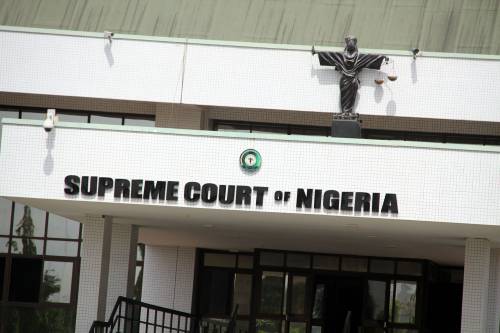
The Supreme Court on Friday dismissed as lacking in merit an appeal filed by the Independent National Electoral Commission (INEC) challenging the leadership of the Social Democratic Party (SDP) and its participation in recent by-elections across the country.
INEC had approached the apex court to set aside the October 17 judgment of the Court of Appeal in Abuja, which upheld an earlier decision compelling the commission to include SDP candidates in by-elections conducted in 12 states of the federation.
The electoral body faulted the appellate court for affirming the judgment of the Abuja Division of the Federal High Court in suit number FHC/ABJ/CS/1525/2025, which was instituted by the SDP. In that suit, the party challenged INEC’s refusal to recognise its candidates, who emerged from primaries monitored by the commission.
INEC argued that the letters and notices submitted by the SDP were invalid because they were signed by the party’s Acting National Chairman, Dr Sadiq Umar Abubakar, and the National Secretary, Dr Olu Agunloye, whom it said had been suspended by the party. The commission maintained that the alleged suspensions rendered all correspondences and nominations signed by the duo invalid.
However, the Federal High Court ordered INEC to recognise and include all SDP candidates in the by-elections. Although INEC complied with the order, it proceeded to challenge the decision at the Court of Appeal.
In a unanimous judgment, a three-member panel of the appellate court led by Justice Adebukola Banjoko dismissed INEC’s appeal and affirmed the high court’s decision.
Dissatisfied with the outcome, INEC further appealed to the Supreme Court. On Friday, a five-member panel of the apex court dismissed the appeal, holding that it had become an academic exercise since the elections had already been conducted and winners sworn in.
In the lead judgment prepared by Justice Mohammed Idris, the Supreme Court said there was no basis to overturn the concurrent findings of the two lower courts.
“The substratum of this appeal has been dissipated. Courts do not engage in interventions on academic questions,” the court held.
The apex court stressed that there was no live issue for determination and declined to entertain questions on the interpretation of the Electoral Act, noting that such issues could not be resolved in a vacuum.
In addition to dismissing the appeal, the Supreme Court awarded a cost of ₦2 million against INEC’s lawyer.